
Nankhatai Recipe


Do you prefer light and crumbly cookies to enjoy with your evening tea? This bite-sized, melt-in-your-mouth Nankhatai recipe is just for you! Just like eggless coconut cookies, these Indian butter cookies require just a few pantry staples and are deceptively easy to make.
So get ready to fill your home with the delightful smell of the Nankhatai recipe, which is an excellent accompaniment to coffee or tea at any time of the day!

What is Nankhatai?
For those unfamiliar with this term, the name Nankhatai comes from the Persian word ‘Naan,' which translates to bread in English, and khatai means light and flaky biscuit.
In simple words, it indicates light and buttery biscuits or Indian shortbread cookies made without eggs or leavening agents (baking powder and baking soda).
I am a cookie lover, and whether it be eggless coconut cookies, Dulce de leche thumbprint cookies, eggless shortbread swirl cookies, or tutti frutti cookies, I love freshly baked golden-brown cookies with my cup of chai.
So, if you are looking for THE perfect cookie recipe for your upcoming tea party, this nankhatai recipe is worth a try.
This best nankhatai recipe will take you back to your childhood days.
Reasons You’ll ♡ Nankhatai recipe
These yummy Nankhatais are absolutely amazing! Soft and flavorful, with the melt-in-the-mouth texture, these little bites of deliciousness indeed have more reasons to be loved.
- Easy and quick to make
- Loved by kids and adults alike
- Perfect make-ahead recipe
- Easy to carry while traveling
- Purely vegetarian
- Satiate sweet cravings instantly!
The best part is that during the festive season, make a huge batch of nankhatais, box them up and share them with family, friends, and neighbors.
Nankhatais, or should I say Indian buttery cookies are a perfect sweet treat for every season and occasion.

The secret to Khasta Nanakhatai Recipe!
This nankhatai recipe is not your regular cut-out sugar cookies. They are the perfect no-fuss, round and buttery shortbread that doesn’t require any fancy ingredients or baking tools.
All you need is a mixing bowl, your fingers, or maybe a spoon, a little refrigeration time before baking, and you are good to go.
The secret to these crumbly yet soft, melt-in-your-mouth nankhatais is ghee. The crunchiness of a nankhatai depends on a good balance of fat and its low moisture content.
During baking, the moisture in the ghee evaporates, producing acceptably stiff and crumbly nankhatais.
So, without further ado, let’s get ready to recapture the joy of your childhood with this khasta (flaky) nankhatai recipe that –
- Takes just a few minutes of hands-on time
- Soft, moist, and delicate, just like the old traditional bakery-bought nankhatais
- Rich and flavorful with a slight hint of cardamom, and
- Incredibly delicious.

Nankhatai Recipe Ingredient List
Flours — I have used a combination of all-purpose flour, chickpea flour (besan), wheat flour, and semolina (sooji) to create this perfect, no-fail nankhatai recipe.
All-purpose flour and wheat flour are the staples, but the addition of besan lends a nice subtle earthy flavor, and likewise, sooji gives a great crunch to the finished cookie nankhatais. This combination lends a sturdy texture, a khasta (crunchy) bite, and a melt-in-your-mouth feeling of a perfect nankhatai.
Powdered Sugar — Also called confectioners’ sugar, the addition of powdered sugar is what makes these nankhatais incredibly soft and delicate. In addition to that, sugar lends crispy edges and smooth texture to our nankhatais.
Cardamom Powder — for a hint of flavor. You can substitute cardamom with your favorite extract.
Salt — An essential ingredient as it draws out the flavor of this nankhatai.
Ghee — Ghee lends a subtle nutty flavor to these Indian buttery cookies. And its low moisture content adds to the crispiness of our nankhatais.
Silvered nuts — as a garnish.

Recipe Tips and Variations
Ghee is an essential ingredient — This delicious recipe of Nankhatai derives its richness, moisture, and soft texture from the ghee. The correct amount of ghee in this recipe is what makes it khasta and delectable. So, do not cut back up on this ingredient.
The right time to add melted ghee — Use semi-solid ( room temperature) ghee when you are combining the flours. The first batch of ghee that's added to the flour mix should be in a granular semi-solid state, not melted. Once the mixture becomes crumbly, then gradually add the melted ghee to the mixture.
Always use powdered sugar — This recipe makes it best with powdered sugar as it absorbs extra moisture from the other ingredients, giving the nankhatai a tender and flaky texture. As it melts, the granulated sugar encourages the nankhatais to spread, take a deeper tinge, and also have a crispier texture; therefore, it should be avoided. Likewise, brown sugar should also be avoided in this recipe.
Do not add any liquid to the mixture — These are low-moisture shortbread cookies, meaning they do not need any added moisture. Most of its moisture and softness are rendered by the ghee. If the mixture doesn’t seem to bind well, feel free to add some more ghee but refrain from adding any liquid to the dough as this may spoil the recipe.

Line the baking tray — Lining the baking tray with parchment paper when baking the nankhatais will ensure easy removal of the nankhatais when baked, and an easy clean-up to follow.
Chill the Nankhatai dough before baking — Refrigerating the dough before baking will provide the dough more stability (the ghee solidifies and takes time to melt when baked) and prevent the nankhatais from spreading in the oven while baking without chilling the dough will otherwise result in the flattened nankhatais. The chilling time also allows the flavors to meld well and come out ideally.
Leave space for spreading — The nankhatais will need space to spread when they are being baked. Therefore, leave enough space between nankhatais when placing them on the baking tray. They may turn out to be sticky and under-baked if placed too close.
Do not over-bake — Overbaking may result in dry and browned nankhatais, so avoid over-baking. Just bake them for 14- 16 minutes or until you see a slightly golden brown on the edges.
For easy lifting — Let the nankhatais sit in the baking tray for 5 - 10 minutes before removing them. Use a very thin spatula to lift them up and immediately transfer them onto a wire cooling rack. Leave them there to cool completely.
To prevent continued cooking — Remove the nankhatais from the baking tray after 5- 10 minutes to prevent continued cooking. They will continue to bake on the hot baking tray if not removed.
Adding a festive vibe — Sprinkle slivered almonds and pistachios on top to render a festive vibe to the freshly prepared nankhatais.
Variations — This is a basic nankhatai recipe. Feel free to improvise and add various flavors to it, like saffron or rose flavor for rose-flavored Nankhatai. Or add some Thandai mix for a Thandai nankhatai recipe.
Go creative with shapes — You can cut the dough into different shapes to make them more appealing to kids.
Do not replace all-purpose four — Replacing all-purpose flour with self-rising flour will not yield significant results because the latter contains baking powder, and the nankhatai recipe doesn’t need any leavening agents!
Confirm doneness — You can know if the nankhatais are done by looking at the edges. If you see the light golden brown rim around the edges, this shows the nankhatais are done. However, the center will still be soft and pale to the touch.
Crumbly Nankhatai — Because they were removed from the tray too soon, Nankhatais are still soft when they come out of the oven, so please resist the urge to touch the nankhatais until they have cooled entirely; otherwise, they will crumble and fall apart. This is extremely important to let the nankhatai sit for 5-10 minutes on the baking tray before lifting them.

LET ME KNOW WHAT YOU THINK!
Can you resist these gorgeous-looking Eggless Buttery Indian Cookies (Nankhatais)? I am sure you can’t!
Neither can I! So, let’s dive straight into the recipe instructions and bake a lovely batch of these adorably delicious Nankhatais that just take a few minutes from the oven to your palate!
Let us begin!
Should you make this Khasta Nankhatai recipe, please let me know your thoughts by sharing your comment below.
And don’t forget to share it with your family and friends.
CRAVING FOR MORE, TRY SOME OTHER Eggless bakes!
| This recipe post has been updated from the archives, first published on August 15, 2015 |
Follow the step-by-step instructions to make the best Nankhatai recipe

Nan Khatai Recipe
INGREDIENTS
FOR NANKHATAI
- 1 cup All purpose flour
- ¼ cup Wheat flour
- ¼ cup Chickpea flour besan
- 2 tablespoons Sooji (Semolina)
- ½ cup Powdered Sugar + 2 tablespoons extra sugar
- ½ teaspoon Cardamom Powder
- - - A pinch of salt
- ½ cup Ghee Semi-solid stage
- 2½ tablespoons Ghee melted
GARNISHES
- - - Slivered Almonds and Pistachios
- - - Cardamom Powder sprinkle on top
INSTRUCTIONS
- Combine all-purpose flour, salt, wheat flour, semolina, chickpea flour (besan), eliachi powder, and powdered sugar in a large mixing bowl.

- Mix until all the ingredients are well blended.

- Add ghee.

- With your fingers, work the ghee into the flour mix.
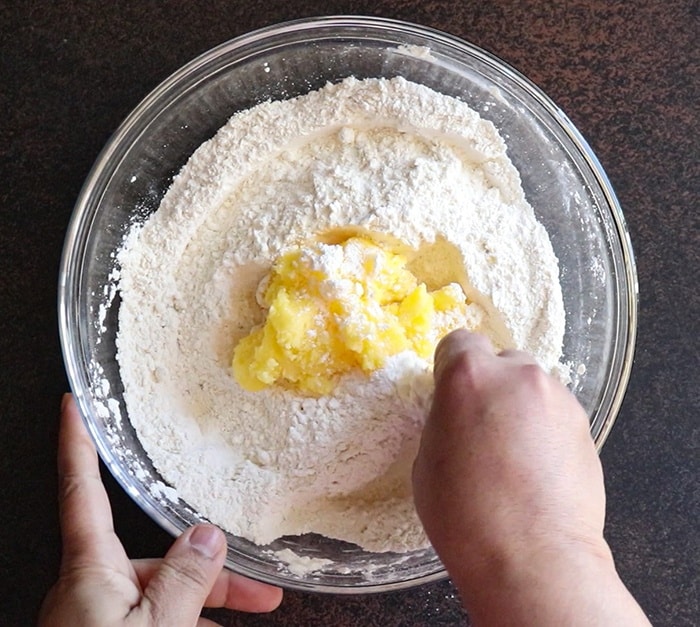
- Mix until the mixture becomes crumbly.

- Add melted ghee to this flour mix and mix until it forms a soft, pliable dough. Add ghee one spoonful at a time, as you may not need the recommended quantity. Tip — When you add melted ghee, the nankhatai dough will be extremely smooth and soft but not sticky.

- Take some dough in your hand, and roll it between your palms to finish rounding it like a ball. Form a crack-free, smooth round ball.

- Flatten the ball slightly in the palm of your hand and use your fingertips to smooth out the edges of your nankhatai.

- Repeat this process until all the dough is shaped.

- Place them on a baking tray.

- Gently make a small cut on top of each nankhatai.Tip — This indent or cross on top will ensure that the nankhatais have room to expand and will develop beautiful cracks during baking.

- Sprinkle eliachi powder. Cover and chill the unbaked nankhatai in the refrigerator for 30 minutes to an hour. Tip — This is an important step, and it will prevent over-spreading. When these chilled cookies are baked, the solidified fat/ghee takes time to melt, and during baking, whatever the steam is released, it puffs up the dough, and the cookie spreads out less and becomes flaky. And if we start baking the dough without chilling, the fat (ghee) will melt immediately, resulting in flat-out, greasy cookies.

- Preheat the oven to 350°F. After the desired time is over, bake the chilled nankhatai in a preheated oven for 14-16 minutes.

- Once the cooking time is done, remove the nankhatai from the oven.

- The center of nankhatai will still be very pale and soft when fresh out of the oven. This is important - let them cool slightly in the tray for 4-5 minutes. As they cool, the nankhatai will continue to firm up.
- Here is what the nankhatai should look like right as they cool.

- Garnish with slivered nuts and store it in an airtight container at room temperature.

VIDEO
RECIPE NOTES
Frequently Asked Questions
Can I skip the cardamom powder? Of course, you can skip the cardamom powder entirely if you don’t have a liking for it, or you can even replace it with vanilla extract or some other flavoring. How can I get perfectly shaped and consistently sized nankhatais? You can use a cookie scooper to form a ball and enjoy the perfectly sized nankhatais! Can I use maple syrup or honey as a replacement for sugar? I would not suggest you add any liquid ingredients as the dough will lose its consistency, and the runny dough will not make the best nankhatais. Can I bake these nankhatais in a pressure cooker? Sure you can. To bake these delicious Nakhatais in a pressure cooker -- Layer the bottom of the pressure cooker with sand or salt.
- Close the lid and heat the cooker on a low flame for 7-8 minutes.
- Arrange a stand in the cooker and place nankhatais over it.
- Bake/cook nankhatais for 5-6 minutes on a medium-low flame.
- Allow the nankhatais to rest for 4-5 minutes, and then gently remove it from the pressure cooker.
- Remember, the nankhatis will be soft at this point. So remove carefully with a spoon.
Can I use butter instead of ghee? Will it give the same texture and result?
I have tried nankhatai with butter, and ghee is what gives them their desired structure and melt-in-your-mouth kind of flaky texture.
Excellent recipe ever! I was unsure about using so much ghee, but it turned out great. Thank you, Ruchi they are really yummy , light and delish. Family loves it.
Thank you, Seema! So glad you liked the recipe. 😊
I'm puzzled by one thing. You say it must be powdered sugar, but then say powdered sugar should NOT be substituted for granulated sugar or brown sugar. The recipe doesn't say to use granulated sugar or brown sugar anyway. Did you actually mean that granulated sugar or brown sugar should not be substituted for powdered sugar? That would make more sense. I have used granulated sugar in the past in a recipe that just said sugar, and the texture didn't turn out right. So I agree that you should not substitute anything else for the powdered sugar.
Helen, oops, did I state the other way around. My bad. I will correct it. This is what I meant - "granulated sugar or brown sugar should not be substituted for powdered sugar."
Made this yesterday. was a hit for the whole family. very yummy.
Thank you, Mishka!
Wow this is a great recipe! Can the dough be rolled and cut into different shapes?
Thank you, Sonia!
Yes, absolutely! You can shape the dough any way your heart desires. 😊
Hi Ruchi! This nan khatai I make with your recipe turns out perfect all the time. Last time was a big hit. Everyone loved it and none was left. So, I had to double the quantity this time. They still came out superb. Thanks for the wonderful recipe!
I was wondering how would they turn out with brown sugar?
Thank you for the feedback, Corrie. 😊
Glad you liked the recipe. Brown sugar will yield the same results, just a slight color variation.
Yum! This looks so delicious and tasty!
Thank you!
Can I not use wheat flour at all?
Shi, this recipe includes 1/4 cup of wheat flour.
Hi Ruchi can I make these without semolina? Thanks
Nam, I have not tried nankhatai without semolina. I think it would work, but I am not sure about the end results.
Hi,
Even if I preheated my oven, my nankhatai started burning in the first three minutes. What could be the reason for it?
Manshi, maybe your oven heats unevenly, and that could be the possible reason for nankhatai burning in the initial stage.
You can try this - stack another sheet tray under the cookie tray (double up the tray) and then bake. Also, try lowering the temperature by 15 degrees.
Hi Ruchi!
Can I use regular sugar instead of powdered sugar for Nankhatais??
I have made ladi Pav following your recipe. It was just mind blowing.
Thankyou so much!!
Vidya
I would not suggest using regular sugar as a substitute. You can ground regular sugar in your blender until it turns into a fine powder, like the consistency. Use this in the recipe.
So glad, you liked the Pav recipe, Vidya. 😊
Thanks for replying 😊
Made these for Eid and they came out AMAZING! Perfect taste, texture everything. Only thing I did differently was add a tad more butter when kneading all the ingredients together as it was slightly too crumbly, after that it was perfect! Thank you for this recipe!
Awesome.
So glad you liked the recipe, Saf!
I dont have all purpose flour.
can i used plain flour instead or self raising flour?
I would not suggest using self-rising flour for this recipe, Lamya.
You see, self-rising flour contains baking powder and nankhatai recipe doesn't require any leavening agents.
All the action comes from the ghee.
Hi can i use maple syrup or honey as an alternative to sugar?
Ayesha, I would not suggest that. This recipe doesn't require any liquid ingredients.
Can we cook it in microwave? At what temperature?
Pratiksha, if your microwave has a baking option, then you sure can bake in it. Bake at the same temperature, as mentioned in the recipe.
Hi, Can I use ghee instead of butter and WWF instead of APF?
Bableen, you can use ghee. Make sure it's in the semi-solid form and not melted.
Regarding wheat flour, I would suggest using half and half - 3/4 cup of all-purpose flour and 3/4 cup of wheat flour.
Let me know how it turns out for you.
Hi I kept the dough in the fridge and wanted to bake them the next day... they have turned hard.. what do I do
Betty, how long did you bake the nankhatais for? Baking them for longer time period will result in hard nankhatai.
Can you please give me the above measurements in grams .
Thanks dear
Hello Geraldine,
Please press 'Metric' at the end of the ingredient list, and you will find the measurements in grams. 😊
Thanks!
Tried the recipe today! They turned out AMAZING! MELTED IN MOUTH.. THANKS FOR SHARING
Glad to hear that!
Thank you so much for your kind words. 😊
Hi Ruchi,
I am going to try this recipe soon. I will let you know my experience.
I would like to know the shelf life of this Nankhatai. For how long will be stay at room temperature.
Also the country I stay has a temperature of 25-32 degree C. And there is aircon system here. No fans.
I hope you I get my query resolve soon.
Thanks in advance.
Regards
Kehul
Kehul, the shelf life for Nankhatai is 10 days at room temperature.
Happy Baking!
Can I use desi ghee instead butter???
Sure you can.
Hello can v bake it in pressure cooker and till how much time
Sure you can.
To bake Nakhatai in a pressure cooker:
1. Layer the bottom of the pressure cooker with sand or salt.
2. Close the lid and heat the cooker for 7-8 minutes on a low flame.
3. Arrange a stand in the cooker and place nankhatai over it.
4. Bake/cook nankhatai for 5-6 minutes on a medium-low flame.
5. Allow the nankhatai to rest for 4-5 minutes and then gently remove from the pressure cooker.
6. Remember the nankhatis will be soft at this point. So remove carefully with a ladle.
Hope this helps!
Can I try the same recipe using cooker and for the same time?
I haven't tried it myself but I am sure you can.