
Gudi Padwa ia a Maharashtrain spring festival. According to Marathi calendar it marks the New Year’s Day for Maharashtrians.
WHEN IS GUDI PADWA CELEBRATED?
 Gudi Padwa is celebrated on the first day of the Hindu month- Chaitra in March/April which also represents the onset of spring or Vasant. In Karnataka this festival is known as Yugadi or Ugadi which means Yug and Adi – beginning of a new year. Sindhi people celebrate this day as Cheti Chand. When Shishir (the cold season) is over crops of wheat, bajra and sunflower are harvested and packed to be marketed.
From Maharashtra ‘s Konkan coast, Gudi Padva brings the smell of Surangi flower and the overwhelming fragrance of mango and jack fruit which are fully reaped by now. Everything smells fresh and new.
HOW IS GUDI PADWA CELEBRATED?
On this joyous occasion people get up early, clean their houses and make colorful rangolis with flowers and colors. Rangoli becomes more elaborate, reflecting the brightness of spring. People wear new clothes and Gudi Padwa is considered as an auspicious occasion to start a new business.
On this festive day, many homes are decorated with coconuts, flowers and mango leaves, symbolizing nature’s bounty to all. The day starts with the eating of the bittersweet leaves of the neem tree. Traditionally, Maharashtrians make a paste of neem leaves mix it with ajwain, tamarind and jaggery and then the entire family eats that paste.
The neem paste is believed to purify the blood and build up immunity in the body against diseases. Many Maharashtrian families prepare Shrikhand and Puran Poli (a sweet roti) on this day. Later in the day, local young boys and men climb on top of each other forming a pyramid and try to break the coconut kept in the gudi.
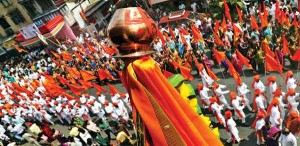
Hoisting colorful ‘Gudi’s’ are the main rituals of this festival. Gudi’s are poles which are covered with yellow colored silk flags and decorated with seasons first coconut leaves or mango twigs which symbolizes a great harvest season. On top of the gudi’s a small brass or silver vessel is inverted which is painted in red.
The gudi’s are then hoisted at the entrance of the house and it is believed that gudi’s ward off evils and bring good fortune and happiness into the house. Gudi’s are also known as ‘Brahmadhavj’ and after they are set up, prayers and pujas are conducted in honor of Lord Brahma, who created the universe after the great destruction (Pralaya).
WHY IS GUDI PADWA CELEBRATED?
 LEGEND 1 – According to Brahma Puran, on this auspicious day Lord Brahma created a new world (Satyug -an era of truth) after the great deluge. Lord Vishnu incarnated himself as Matsya Avatar (the Fish Incarnation) and saved the mankind from prahlaya (destruction). Gudi Padwa is especially dedicated to the worship of Lord Brahma.
 LEGEND 2 – Gudi Padwa is a very sacred occasion and other legend says that this festival is celebrated to commemorate the victory of Lord Rama over the demon king Ravana. By hoisting Gudi’s at the entrance of every house people express their happiness as their beloved King Lord Rama returned from exile after 14 years. It symbolizes the victory of good over evil.
 LEGEND 3 –People in Maharashtra celebrate Gudi Padwa in honor of Chatrapati Shivaji Maharaj, a great Maratha leader. Under the supervision of their leader Shivaji Maharaj, the Maratha forces fought bravely with Mughals and defeated them. Gudi’s were raised in honor of the brave Maratha soldiers as a sign of victory over the Mughals, thus celebrating peace and happiness. Today, gudi’s are displayed in front of every house and windows as it is believed that it wards off the evil and brings good fortune.
Ruchi great way of explaining festival.Please write about other festivals.
Regards
Charu
Thanks Charu. It’s a work in progress and we will update all the festivals closer to their dates.
Wow! How beautifully you wrote about when we celebrate Gudi Padwa? and how we celebrate Gudi Padwa? Then you very nicely explained about what is the story behind celebrating gudi padwa. I really got to know new things about why we celebrate gudi padwa. Thank you so much for the post.