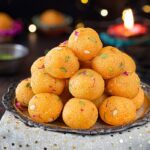
Motichoor Ladoo
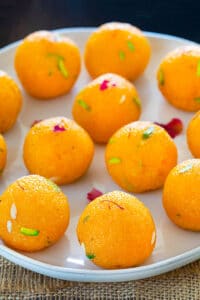
Indian sweets and desserts are a pure representation of happiness and excitement, and Motichoor Ladoos are the special ones among them. They truly uplift the aura of any celebration or festivity! Their heavenly and luscious taste naturally renders festive vibes, and one can never overcome the bliss that it derives!
Servings: 16
Calories: 77kcal
Ingredients
FOR BOONDIS
- 1 cup Besan (Chickpea flour/ Gram flour)
- ⅛ teaspoon Orange food color
- ½ cup Water + 2 tablespoons more
- - - Ghee for frying (Oil is also an option)
SUGAR SYRUP PREPARATION
- 1 cup Sugar
- ½ cup Water
- 1½ teaspoons Rose water
- ½ teaspoon Cardamom Powder
- 1 teaspoon Lemon Juice
- A pinch of Saffron
- A pinch of Orange food color
ASSEMBLING LADOOS
- - - Melon Seeds
- - - Crushed Pistachios
Instructions
SUGAR SYRUP PREPARATION
- Combine sugar and water into a wide pan.

- Bring it to a boil and add lemon juice to prevent crystallization.

- Add saffron strands and cardamom powder to the cooking sugar syrup.

- Allow the sugar syrup to simmer over medium heat until it reaches one-string consistency. It will take 7-10 minutes to get one string consistency.

- Check consistency – take some cooled sugar syrup between your fingers, press the fingers down, and now open your fingers; if it forms a thick string between your fingers without breaking – sugar syrup is ready to use. Cover and set it aside.

PREPARE BOONDI
- Combine besan, food color, and a teaspoon of ghee in a mixing bowl.

- Add a little water at first and make a lump-free thick batter.

- Slowly and gradually add water to make a smooth, lump-free, and pourable batter. PROTIP – If the batter is of the right consistency, it will fall into the oil as even-sized tiny droplets resulting in perfect motichoor boondi.

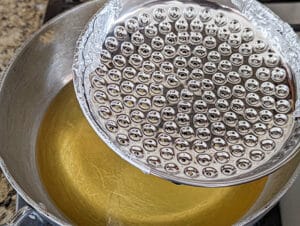
- Since I didn’t have the right motichoor jhara, I converted my size 2 boondi jhara to a size 0 by wrapping it in aluminum foil.
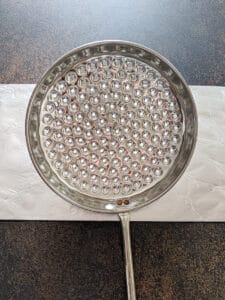
- If you plan to use this method, please make sure the foil is tightly secured around the jhara.
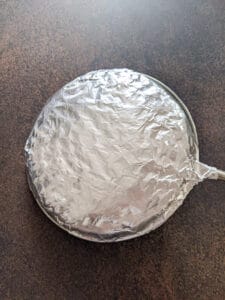
- Then, using a push-pin, I created tiny holes through the jhara. This effectively served the purpose and helped me make my best Motichur Ladoos!

- Heat oil in a pan. Always use a wide kadhai to fry the boondis. The kadhai should be wider than the size of the jhara. This way, when you tap the jhara over the kadhai, the batter falls straight into the kadhai rather than on the edges.
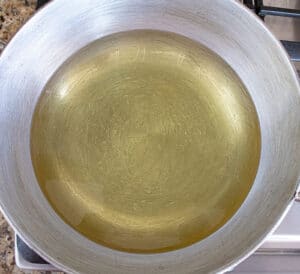
- To check that, drop a little batter in the oil; if it gently floats to the top, the oil is ready.

- While frying the boondi, create a higher platform so that the jhara is 3-4 inches above the oil.
- I used a container lined with a thick cloth and then placed the jhara on top to support it.

- Once the ghee/oil is hot, pour the batter through this jhara. Shake it vigorously (up and down) over the oil so that the whole batter drops through those holes as tiny droplets. Once the boondi is in oil, you have very little time. Fry them for a minute, then remove them immediately before the boondis start to change color. Do not over-fry the boondis. PROTIP – The thick cloth underneath the container acts as a cushion when you vigorously shake the jhara over oil to drop the batter in the oil. Make sure the handle of the jhara is resting over the container and does not come in close contact with the hot oil in the kadhai.

- Use a fat skimmer to collect the fried boondis. PROTIP – We do not need crisp boondi for motichoor. Since they are very tiny in size, they will cook fast; therefore, be quick in removing the motichoor boondi from oil at the right time. A crisp boondi is not good for motichoor ladoos.

- You can also use a tea strainer, but it has a small handle. A fat skimmer with a long handle works the best.
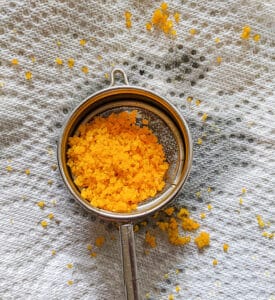
- Always drain fried boondi onto a paper-lined plate to ensure that extra oil is drained from the boondis. Spread the boondi in a single layer over the paper napkin to drain maximum oil. To prevent the fried boondi from drying out, cover the boondi with a lid while you fry the whole batch.

- Perfectly shaped motichoor boondis are ready for the sugar syrup.

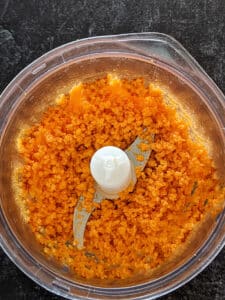
- During the last leg of frying, my besan batter became thick, and it spread between the holes of funnel-shaped jhara resulting in some large-sized boondis. If this happens with you too, do not discard these boondi; transfer them to a food processor and pulse them into smaller pieces.
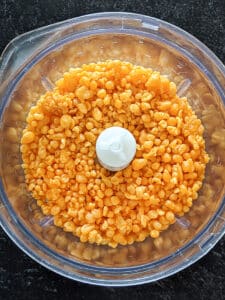
- Lightly pulse big pieces and then add them to the remaining boondi.
ASSEMBLE MOTICHOOR LADOOS
- If the sugar syrup has cooled down, bring it to a quick boil. Lower the heat to the lowest setting, then add the fried motichoor boondis to this pan.

- Cook the boondi for 1-2 minutes at the lowest setting, stirring continuously. This way, the boondi will become soft and soak in the sugar syrup. PROTIP – Do not cook for long as overcooking will result in dry boondi ladoo.

- Take the pan off the heat and add slivered pistachios and melon seeds. Cover the pan and let it rest for an additional 1-2 minutes.
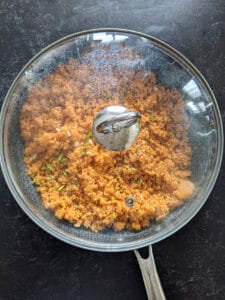
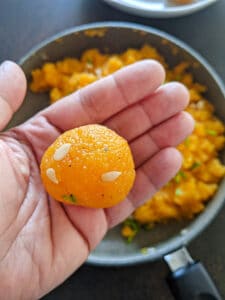
- After that, uncover the pan and allow the motichoor mixture to cool slightly. When comfortable enough to touch, take a golf-sized mix into your palms and roll them into spherical-shaped ladoos. Repeat the same with the remaining mix and shape all the ladoos.
- Motichoor ladoos also have a long shelf life and can be made in advance for any celebration or event.
Video
Notes
Frequently asked questions
What is the perfect temperature for frying boondi? Having the right temperature is imperative when you drop boondi in the oil. If the boondi begins to float on the oil after some time, it confirms the perfect temperature. How can I store the Motichur ladoos? Motichur Ladoos have a long shelf life. The ladoos solidify after being shaped and cooled to room temperature. They stay perfect at room temperature for 8 -10 days and for a month in the fridge. Can I freeze Motichoor Ladoo? Absolutely, you can! Motichoor ladoos freeze well for about a month when stored in a freezer-safe container. What can I do if my Ladoos have turned hard? Bringing the Motichur ladoos back to their soft deliciousness is super easy. Just crush them again, add some ghee, warm the mix, and re-shape them. It’s that easy!! Why do my boondis turn flat? During the frying process, you may end up with some flat balls of boondi. There are three basic tricks to attain the perfectly puffed up boondi —- First, ensure that the consistency of the batter is thick yet flowing. Runny batter will result in flat boondi.
- Second, ensure that the oil temperature is perfect when you make the boondi. Perfect means a low-medium temperature where the pearls/ boondi start floating soon after a while when the batter is put in the hot oil.
- Third, hold the jhara above the kadhai/frying pan, resulting in small round boondis.
Nutrition
Calories: 77kcal | Carbohydrates: 17g | Protein: 2g | Fat: 1g | Saturated Fat: 1g | Polyunsaturated Fat: 1g | Monounsaturated Fat: 1g | Sodium: 5mg | Potassium: 65mg | Fiber: 1g | Sugar: 13g | Vitamin A: 3IU | Vitamin C: 1mg | Calcium: 4mg | Iron: 1mg