

Dhanteras marks the beginning of the five day Diwali festival. It’s the first day when the festivities begin. The word Dhanteras comes from a sanskrit word Dhan which means wealth and teras means “the thirteen day”. Dhanteras is also referred as “Dhantrayodashi” or “Dhanwantari Triodasi”.God Yama is worshiped on this day to provide prosperity and well being.
WHEN IS DHANTERAS CELEBRATED?
According to the lunar calendar, Dhanteras falls on the thirteenth day of the dark fortnight in the month of Kartik (October-November), i.e. two days before Diwali. Dhanteras is considered one of the most auspicious occasions by Hindus to buy Gold ornaments and utensils.
WHY IS DHANTERAS CELEBRATED?
Every Indian festival has a legend associated with it and Dhanteras too has some interesting legends related to it.
Legend 1 – Son of King Hima – A very interesting story about this day is of the sixteen year old son of King Hima. As per his horoscope he was doomed to die by a snake-bite on the fourth day of his marriage. On that particular fourth day of his marriage his young wife did not allow him to sleep. She laid all the ornaments and lots of gold and silver coins in a big heap at the entrance of her husband’s bedroom and lighted innumerable lamps all over the place. And she went on telling stories and singing songs.
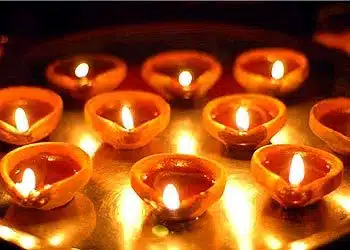 When Yam, the god of Death arrived there disguised as a Serpent his eyes got blinded by the dazzle of those brilliant lights and he could not enter the Prince’s chamber. So he climbed on top of the heap of the ornaments and coins and sat there whole night listening to the melodious songs. In the morning he quietly went away.
Thus the young wife saved her husband from the clutches of death. Since then this day of Dhanteras came to be known as the day of “YAMADEEPDAAN” and lamps are kept burning throughout the night in the glory of Yam devta, the god of Death.
Lengend 2 – Samudra Manthan – According to a legend, during Lord’s Vishnu’s second incarnation – the gods and demons churned the ocean for Amrit or nectar and among the 14 things which came out as a result of samudra manthan – Dhanavantri(the physician of gods and an incarnation of Vishnu) emerged carrying a jar of elixir. It is also believed that Dhanteras gets its name from Dhanvantri. READ MORE ABOUT SAMUDRA MANTHAN AND VISHNU’S SECOND INCARNATION.
Dhanteras is a great month for business community because on this auspicious day, as per Hindu custom women of the house purchase jewelry and utensils. The new purchases are dedicated to Goddess Lakshmi and Lakshmi Pujan in the evening is an important ritual on this day. Dhanteras is a very fortunate day and people start new ventures on this day. It is believed that on this day Goddess Lakshmi bless people’s live with immense wealth and prosperity.
HOW IS DHANTERAS CELEBRATED?
All around India these five days of Diwali including Dhanteras is known for its grand scale of festivity. As such this day has a great importance for the rich mercantile community of 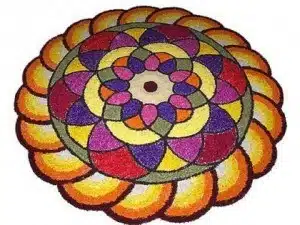 India. Houses, offices and business premises are renovated and decorated. Entrances are made colorful with lovely traditional motifs of Rangoli designs to welcome the Goddess of wealth and prosperity. Flowers and beautiful array adorn the entrance of houses and offices. To indicate her long-awaited arrival, small footprints are drawn with rice flour and vermilion powder all over the houses. Lamps are kept burning all through the nights.
 Believing this day to be auspicious women purchase some gold or silver or at least one or two new utensils. New dhan or some form of precious metal is bought as a sign of good luck.”Lakshmi-Puja” is performed in the evenings when tiny diyas of clay are lighted to drive away the shadows of evil spirits. “Bhajans”-devotional songs- in praise of Goddess Laxmi are sung.
In villages cattle’s are adorned and worshiped by farmers as they form the main source of their income. In south cows are offered special veneration as they are supposed to be the incarnation of Goddess Lakshmi and therefore they are adorned and worshiped on this day.
There is a peculiar custom in Maharashtra to lightly pound dry coriander seeds with jaggery and offer as Naivedya. Elaborate sweets and savories are made as naivedya and offered ritualistically to deities. Along with naivedya, Panchamrit – a holy mixture made of equal parts of honey, ghee, sugar, yogurt and milk is also offered.
Dhanteras is not all about wealth, it’s also a time for family reunions and bonding. Family and relatives meet and greet each other on this day. Aartis and prayers are sung to please the Goddesses and it creates a divine environment and fills everyone’s heart with spiritualism.
AARTI OF JAI LAKSHMI MA IN HINDI

AARTI OF JAI LAKSHMI MA IN ENGLISH
Om Jai Lakshmi mata, maya jai Lakshmi mata,
Tumko nishdin Sevat(2),
Hara Vishnu vidhata, Jai Lakshmi…||
Brahmani, Rudrani Kamala, tuhi hai jagmata,
Surya chandrama dhyavat(2),
Narad rishi gata, Om Jai Lakshmi…||
Durga roop nirantar, sukh sampati data,
Jo koi tumko dhyavat2), riddhi siddhi dhan pata, Om Jai Lakshmi…||
Tuhi hai patal Basanti, tuhi shubh data,
Karma prabhav prakashini(2),bhavnidhi ki trata,
Om Jai Lakshmi…||
Jisghar men tum rahati, sab sadgun ata,
Sab sambhav ho jata (2), man nahin ghabrata,
Om Jai Lakshmi….||
Tum bin yagya na hove, vastra na koi pata,
Khan pan ka vaibhav(2), sab tumse ata,
Om Jai Lakshmi…||
Shubh gun mandir sundar, Kshirodadhi jata,
Ratan chaturdash tumbin(2), koi nahih pata,
Om Jai Lakshmi…||
Arti Lakshmi ji ki, jo koi nar gata,
Ur anand smata(2), pap utar jata,
Om Jai Lakshmi mata…||
It’s an awesome article in support of all the festivals; stunning and extrodinary way of explaining Indian festivals. Keep up the good work!!
Thanks and glad you liked it:)